Friday, 6 March 2015

What are the bad habits to look out for when recruiting salespeople? - and how a specialist sales recruitment agency can help.


The fact is, we all have bad habits! Yes, even me, and probably you too. 

The habits I’m referring to are things we do in our professional lives in order to make the day go faster, easier and involve less work. So what are the bad habits to look out for when you have a sales job available and you are recruiting sales staff?

Administration

Lots of salespeople dislike administration. They tend not to do it properly because it cuts into their selling time. They perceive it to be non-productive so they avoid doing it, always leaving it “until tomorrow.”
The problem is, as we all know, tomorrow never comes and the poor sales guy end up with a pile of incomplete “paperwork”, which nowadays probably doesn't involve paper at all, cluttering up his desk – and his brain.

The result? Things don’t get done, or they get done too late, colleagues are not kept up-to-date with what is going on in the salesperson’s world and things start to break up.

How to spot it at an interview – ask a question like “tell me about your typical day, how do you divide up your time?” If there's no mention of the "a" word, you might want to move onto the next candidate.

Good sales “PR”

Although salespeople frequently operate out in the field, they tend to forget that their colleagues, or at least the office-based ones, do not. Whereas a good field salesperson could, and should, be out and about when the customer has requested to see them, or when there is a good chance of catching someone, the staff that support them back in the office usually work to “normal” office hours.

If you start the day at 6am in order to get to a client for an early meeting because that’s the only time he or she could see you, which is very much the case in a lot of sales jobs, then you could be forgiven for taking a breakfast break after that meeting and then making your way into the office.

Your colleagues, however, may simply see that as “the salespeople here do as they want, turn up when they can be bothered,” being unaware of the actual facts or choosing to ignore them.

The salesperson should always ensure that at least one other person in the office knows their diary, where they are and when they have to be there – this information will percolate around the business and, as a result, colleagues will be aware of the schedule the salesperson has to keep and will think more highly of them although I wouldn't over egg that particular pudding.

How to spot it at an interview – “do you keep a diary, do you share it with colleagues?” “Is it an online diary or the old fashioned paper type?”

Is he or she a team player?

If you ask whether someone is a team player they will probably say that they are, because that's the way many organisations think that work should be structured, but are they really?

Most sales jobs actually involve a team, even if the business does not have a formal team structure.

The marketing department generates leads, the salesman follows those leads up and closes the business, probably after a demonstration by the sales support people, then the production staff, or the buyers, warehouse people and so on, all move in to play their part.

It’s almost always a team effort of one sort or another.

So, when recruiting sales staff and sitting in front of the latest candidate for your sales job, it’s important to know how he or she will fit into the overall structure of the business.

If the salesperson takes a disproportionate amount of the “credit” for the sale it can cause bad feeling and work against the interests of the business so try to nip it in the bud before it happens.

How to spot it at an interview - at an interview, spot the “Lone Rangers” by asking questions like “in your current sales job, how many people are involved in the average sale, from enquiry to delivery, and who are they, (roles, not names)?”

If the answer is “one” or “just me” then proceed with caution.

OK, I know these aren't really bad habits like some I could, but won’t, mention, but they are potential problem pits just waiting to open up and swallow up your time and resources if you are not careful.

When you need to recruit sales staff and be confident that you are talking to candidates that will really fit in with your business culture, always contact a specialist sales recruitment agency like Aaron Wallis. We can pre-screen candidates for your sales jobs and save you time today – and problems further down the line.



Saturday, 28 February 2015

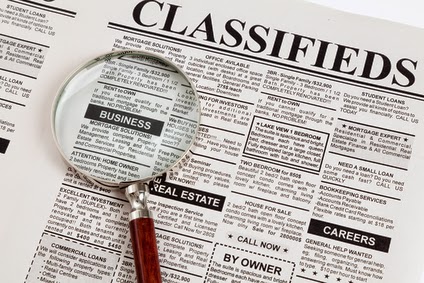
Whether Recruiting Sales Staff, Looking for a sales Job or selling a car – does anyone use newspaper classified ads anymore?

It’s Thursday, it’s roughly lunchtime and it’s job advertising day in my local newspaper. I make up an excuse and take an early lunch so that I can make a bee line to the nearest newsagent and pick up a copy. Then it’s off to the canteen to browse the pages of job ads, all presented under the somewhat grandiose title of “situations vacant.”

OK, now that was thirty or so years ago and let me make it clear that I am fully aware that lots of local, and indeed national, newspaper still run ads for job vacancies. My argument is that they are much less common and the number of jobs advertised is smaller.
This can be attributed to a number of factors of which, of course, the main one is probably that the decline in sales of newspapers in the UK is currently happening at around 8% per year. This is often blamed entirely on the Internet and online news sources being more attractive to the consumer but that is only partially correct.

A long, slow decline

In fact, newspaper sales have been declining steadily since the early 1980’s, well before the World Wide Web took its hold over our lives and presented us with so many options and choices that it can sometimes be overwhelming.
On the other hand, some newspapers have survived by changing to a free issue model, London’s Evening Standard, which became free in October 2009, being a well-known case in point, and anyone who has traveled on a train will have been given the option of reading The Metro, completely free of charge, and paid for by advertising revenue – some of which is recruitment advertising.
As an employer, wishing to recruit staff, the number of choices is also mind-boggling. There are still print adverts to be had, locally and nationally, and no doubt this will continue to be the case for years to come.

Classifed job ads live on, but they're less likely to be of the printed variety

The alternative means of advertising for sales staff, technical staff and everything in-between is to go with one or more of the online recruitment websites. There you will find advertisements for everything from cleaners to cooks, shop assistants to secretaries, mechanics to managers and everything in-between. The range of vacancies on offer can be bewildering and, for that reason, sometimes wrong decisions can be made.
When it comes to recruiting staff for specialist jobs, such as IT sales staff, software sales staff or electrical sales staff then there is a case for moving away from the one-size-fits-all approach of many of the big job websites and looking towards more specialist recruitment agencies for a solution.
This is a tried and tested approach that has its history in the classified ads that were run in Industry Specific publication titles that serve a particular market. Many industries had, and still have, their own newspapers and magazines which carry news that is relevant to that industry but of little interest to anyone outside of it. It is to those publications that employers seeking to recruit specialist staff turn because they know that they will be read by those in the industry or who wish to become involved in that industry.
Similarly, if you are wanting to recruit sales staff, perhaps specialist financial sales staff, medical sales staff and so on, then it also pays dividends to stick to the specialists. Aaron Wallis are a specialist sales recruitment agency and work tirelessly to find the best candidates for their client’s vacant sales jobs.

Do whatever it takes to find the right person for your vacant sales jobs

Your next new member of the sales team probably won’t find you by way of a newspaper classified ad, but if he or she has access to email, the Internet or a smartphone or tablet, then if they don’t find you, we will almost certainly be able to find them for you.
We maintain a database of candidates who have been carefully screened and assessed so that we know exactly who to recommend them to when the right sales job becomes available.

Online ads, specialist recruitment websites, networking and social media websites and dedicated people just like us, have made it much easier to recruit the right sales staff for your sales jobs, all over the UK and beyond.

Thursday, 26 February 2015

Now that we all interact with each other in different ways, thanks to technology, what new qualities should you look for when recruiting sales staff?

My kind of salesman, my kind of sales job

One of my favourite episodes of my all-time favourite comedy show, Dad's Army, was the one in which Captain Mainwairing's "twin" brother shows up to discredit his bank manager sibling by claiming that he had stolen a watch left to him by their deceased father.

When asked by one of the soldiers, what he did for a living, the somewhat sozzled brother replied that he was a salesman - actually what he said was that he "travelled in novelties," (meaning that he sold jokes and cheap toys), and then produced a few joke-shop tricks to show to the men in the regiment.

Although by today's standards, swigging from a hip flask, dressed in a flamboyant but slightly unkempt way and visiting his customers almost as if it was a social occasion and not a business appointment would be strictly non-acceptable behaviour for a sales person, in those days, it wasn't.

I'm not suggesting that people tolerated drunkenness in the workplace of course, the character was exaggerated for comedy effect, but the underlying point stands. Field sales jobs were almost entirely a male territory and salespeople were expected to be personalities, taking clients to lunches that lasted most of the afternoon and doing deals on the shake of a hand and without a shred of due diligence or a credit check in sight.

Product knowledge was important but not in an obsessive way, the social skills of a salesperson outweighed the product knowledge in terms of importance, by a long chalk.

The saying, "people buy people" was certainly true then, as it is now, but for different reasons.

So, back to the point - what qualities do you need to look for in a candidate when recruiting a salesperson to fill one of your sales jobs and how do they differ from just a few years ago let alone from the days when Captain Mainwairing and his army of geriatric heroes saved us all from the threat of the Hun?

It's time to be sociable - again

The answer, I would suggest, is not so great as you might think. Thanks to technology, we've learned to be sociable again, but in a totally different way and the line between personal interaction with friends and with business associates has been blurred. It can all be blamed on Social Media - Facebook, Twitter, Google+, YouTube and, of course, LinkedIn.

Many of us reveal a lot more about ourselves than we realise when we take part in social media exchanges. We know much more about our customers before we contact them, or call on them, because they voluntarily make that information available on their websites and on social media sites.

A canny salesperson, who knows how to use and manipulate LinkedIn Groups and to deep-dive into the demographic data on Facebook and Twitter, is at a distinct advantage when picking up the telephone to speak to those prospective clients.

If he or she has access to a carefully maintained CRM and prospect database then a much greater depth of knowledge can be gained about the person he or she is going to interact with in the hope of landing some business.

Not only that, but there are so many more ways of interacting with those people than there ever were before. Mainwairing's brother packed his whole business into a kit bag and carted it around with him. Now, that is rarely necessary - in most sales jobs a few videos and a slide deck and the job is done.

More to think about when recruiting for sales jobs

So now we should be thinking in terms of recruiting sales staff who have a good understanding of how their customers and prospective customers tick by way of their understanding of how social media ticks.

Nowadays, the winners are the ones who can pick up on a Tweet that indicates someone may be in the market for your product or service, or intercept and interact with a conversation about your product or others like it in a LinkedIn thread or a Facebook post. Wherever this "Buzz", as it is called, its taking place your sales staff should be aware of it and interacting with it, creating opportunities, creating sales.

So at your next sales recruitment interview, along with all the "usual" questions, remember to ask a few to establish how at home the candidate is with the art of being sociable and interacting with people, online and off.

Specialist sales recruitment agencies like Aaron Wallis will provide you with all the right questions to ask when recruiting sales staff, having already screened the candidates to include only those with genuine potential to add value to your business. Contact us today and discuss the sales jobs you may with to recruit for - we're always happy to help.